

Most crypto users don’t leave an app because they dislike crypto.
They leave because the experience fails them.
Slow loading, confusing interfaces, unclear security these small issues create big trust gaps. In a market where users expect instant performance and complete control, even a few seconds of friction can push them away.
That’s why DeFi wallets are becoming essential. A well-built DeFi wallet offers speed, security, and simplicity giving users full ownership of their digital assets without relying on intermediaries.
In this guide, we’ll explore how DeFi wallet development works, key features, real-world use cases, and how you can build a wallet users trust and continue to use.
DeFi Wallet Development – A Simple Overview
DeFi wallet development is all about creating digital wallets that let users manage their crypto and interact with decentralized finance platforms directly. With these wallets, users can lend, borrow, stake, swap tokens, and trade without relying on banks or centralized exchanges.
There are two main types of DeFi wallets:
Custodial wallets, where a third party manages private keys
Non-custodial wallets, where users control their own private keys and funds
Most users prefer non-custodial wallets because they offer full ownership and transparency.
DeFi Wallet Development Company
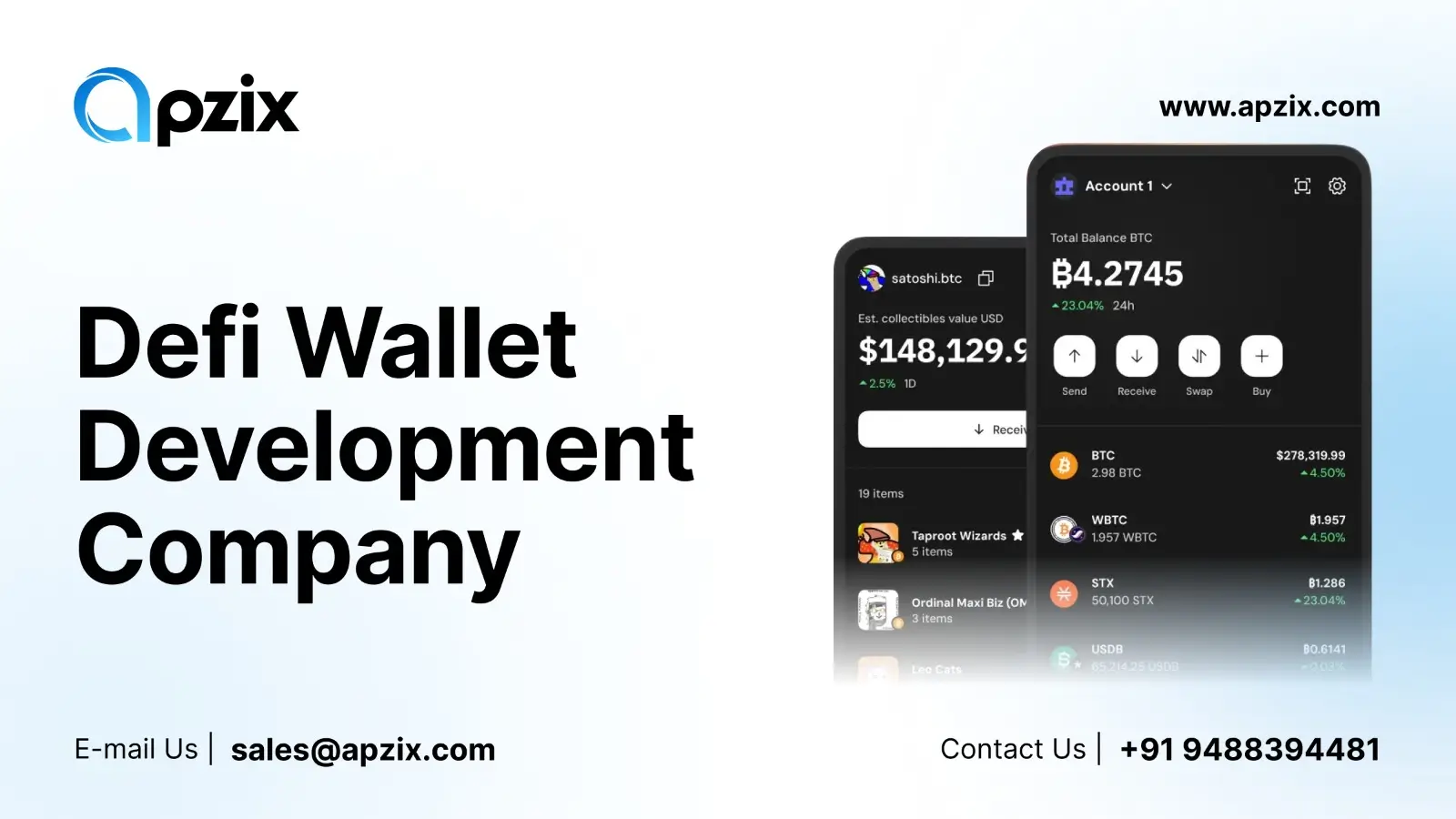
A DeFi wallet development company designs and implements blockchain-based wallet applications that enable users to manage digital assets, sign transactions, and interact with smart contracts across decentralized networks. These wallets integrate with DeFi protocols to support functions such as token transfers, staking, liquidity provision, lending, and decentralized exchanges.ApziX builds DeFi wallet solutions with a focus on cryptographic security, key management, and blockchain protocol integration. Our wallets support multi-chain architectures, secure private key storage, and modular feature extensions to meet platform-specific requirements.
Key Features of Our DeFi Wallet Development Solutions
A modern DeFi wallet must combine security, usability, and blockchain interoperability. At ApziX, we design DeFi wallet solutions with advanced architecture and user-focused features to meet enterprise and market demands.
Simple User Interface
Our DeFi wallet solutions are designed with intuitive dashboards, simplified transaction flows, and clear asset management views. Users can easily send, receive, and monitor their crypto holdings without technical knowledge. The UI is optimized for both beginners and advanced crypto users, ensuring smooth onboarding and engagement.
QR Code Scanning
QR code scanning simplifies crypto transactions by eliminating manual address input. Users can scan a QR code to send or receive digital assets instantly, reducing the risk of incorrect addresses and transaction failures.This feature enhances speed, accuracy, and convenience, making crypto payments accessible for everyday use cases.
Multi-Currency Support
Our DeFi wallets support multiple cryptocurrencies and blockchain networks, including Ethereum, BNB Chain, Polygon, TRON, and other major protocols.
Users can store, manage, and transfer different digital assets in a single wallet, eliminating the need for multiple applications. This multi-chain capability provides flexibility for traders, investors, and DeFi users.
Non-Custodial Storage
Non-custodial architecture ensures users maintain full control over their private keys and digital assets. Private keys are generated and stored locally on the user’s device, not on centralized servers.This approach eliminates third-party risk and aligns with the core principles of decentralization, privacy, and financial sovereignty.
NFC Payment Capability
NFC (Near Field Communication) technology enables contactless crypto payments with a simple tap. This feature supports real-world payment scenarios such as retail purchases, ticketing, and point-of-sale crypto transactions.NFC integration bridges the gap between blockchain payments and traditional financial systems, offering faster and more convenient crypto transactions.
Smart Contract Integration
Smart contract APIs allow automated execution of DeFi operations such as token swaps, staking rewards, lending contracts, and liquidity pool interactions.
Our wallets integrate with smart contracts to ensure transparency, automation, and trustless execution of financial transactions. This reduces manual intervention and enhances operational efficiency.
Multi-Factor Authentication (MFA)
Security is strengthened through multiple authentication layers, including biometrics, OTP verification, and device-based authentication. MFA ensures that only authorized users can access wallet accounts and approve transactions.This reduces the risk of hacking, unauthorized access, and account compromise.
AML & KYC Features
Our DeFi wallets can integrate AML (Anti-Money Laundering) and KYC (Know Your Customer) verification modules to meet regulatory compliance requirements.
These features help businesses prevent fraud, monitor suspicious activities, and comply with global crypto regulations. KYC integration also builds trust with users and institutional partners.
How DeFi Wallet Software Works?
A DeFi wallet allows users to manage crypto without intermediaries. Here’s how it functions:
Private Key
When a user creates a wallet, a private key is generated and stored on their device. This key proves ownership of funds and is required to approve transactions.
Public Address
The wallet also creates a public address that users can share to receive crypto. It works like a blockchain account number.
Connecting with dApps
Users can connect their wallet to decentralized apps such as exchanges, lending platforms, NFT marketplaces, and staking protocols.
Transaction Signing
Whenever a user sends crypto, the wallet signs the transaction with the private key before sending it to the blockchain network.
Full User Control
In non-custodial wallets, the provider never stores private keys. Users have complete control over their assets.
Multi-Blockchain Support
Modern wallets support multiple blockchains like Ethereum, BNB Chain, Polygon, and more, allowing users to manage various tokens in one place.
Security Mechanisms
Encryption, recovery phrases, biometrics, and two-factor authentication protect wallets from unauthorized access and cyber threats.
Tech Stack for DeFi Wallet App Development
Building a DeFi wallet requires a robust and secure technology stack that supports blockchain integration, cryptographic security, scalability, and user experience. Below is a comprehensive tech stack used for modern DeFi wallet application development.
1. Blockchain
Ethereum
Binance Smart Chain (BSC)
Polygon
TRON
Solana
Avalanche
Bitcoin (for BTC wallet support)
2. Frontend
React.js
Next.js
Angular
Vue.js
3.Backend
Node.js
Python (Django / Flask)
Golang
Java (Spring Boot)
APIs & Services
Web3.js / Ethers.js
RESTful APIs
GraphQL
4.Smart Contract Development
Solidity (Ethereum, BSC, Polygon)
Rust (Solana)
Vyper
Development Tools
Hardhat
Truffle
Remix
Foundry
5. Wallet Infrastructure & Node Services
Infura
Alchemy
QuickNode
Self-hosted full nodes
RPC endpoints
6. Database & Storage Technologies
MongoDB
PostgreSQL
MySQL
Redis
Decentralized Storage
IPFS
Filecoin
Arweave
7.DevOps & Cloud Infrastructure
AWS, Google Cloud
Microsoft Azure
DevOps Tools
Docker
Kubernetes
CI/CD pipelines
Terraform
Use Cases of DeFi Wallet Development
DeFi wallets are not just storage tools. They function as gateways to decentralized financial ecosystems, enabling users to manage assets, interact with smart contracts, and access financial services without intermediaries. Below are key real-world use cases that highlight the practical value of DeFi wallet development.
1. Secure Crypto Management
DeFi wallets provide a secure environment for storing and managing digital assets. Unlike centralized exchanges, non-custodial wallets give users full control over their private keys and funds.Users can send, receive, and store cryptocurrencies directly on the blockchain without depending on third-party platforms. This eliminates counterparty risks such as exchange hacks, account freezes, or fund mismanagement.DeFi wallets also support portfolio tracking, transaction history, and asset categorization, helping users monitor their holdings in real time.
2. Peer-to-Peer Lending and Borrowing
DeFi wallets enable users to participate in decentralized lending and borrowing protocols. Crypto holders can lend their assets to earn interest, while borrowers can access liquidity by providing crypto as collateral.These transactions are governed by smart contracts, ensuring automated execution without intermediaries. Interest rates are determined by market demand, providing transparent and efficient financial services.This use case is especially valuable for investors, traders, and DeFi participants seeking passive income or liquidity without traditional banking systems.
3. Advanced Security Access
Security is a critical requirement in crypto applications. DeFi wallets incorporate multiple authentication mechanisms to protect user accounts and assets.
These security layers may include private key encryption, biometric authentication, multi-factor authentication (MFA), hardware wallet integration, and recovery phrase management. Together, they reduce the risk of unauthorized access, phishing attacks, and credential theft.
Advanced security frameworks also support device-based authentication and transaction approval workflows for enterprise-grade wallet platforms.
4. Instant Crypto Transactions
DeFi wallets allow users to transfer cryptocurrencies globally within seconds or minutes, depending on the blockchain network. Unlike traditional financial systems, transactions do not require banks, clearinghouses, or intermediaries.Transaction fees are often lower compared to conventional banking services, especially for cross-border payments. This makes DeFi wallets suitable for remittances, merchant payments, and real-time financial settlements.
Users can also monitor transaction status and confirmations directly on the blockchain explorer through wallet integrations.
5. DeFi App Integration
DeFi wallets act as gateways to decentralized applications (dApps), enabling users to interact with a wide range of blockchain-based financial services.
Users can connect their wallets to decentralized exchanges (DEXs), staking platforms, liquidity pools, yield farming protocols, NFT marketplaces, and Web3 applications.This integration allows them to execute DeFi activities directly from their wallet interface.By supporting Web3 providers and smart contract interactions, DeFi wallets provide a unified access point to the decentralized ecosystem.
Why Choose ApziX for DeFi Wallet Development?
Building a DeFi wallet requires deep blockchain expertise, strong security architecture, and a user-centric product design approach. This is where ApziX stands out as a trusted crypto wallet development company delivering enterprise-grade blockchain solutions.
We develop DeFi wallets with advanced capabilities, including:
- Multi-chain compatibility to support multiple blockchain networks such as Ethereum, BNB Chain, Polygon, and TRON
- Non-custodial architecture that gives users full control over their private keys and digital assets
- Biometric authentication for secure and convenient account access
- Advanced encryption mechanisms to protect wallet data and transaction integrity
- DeFi and staking integrations for lending, borrowing, yield farming, and liquidity protocols
- Custom UI/UX design to ensure a smooth and intuitive user experience across devices
As a leading cryptocurrency wallet development company, ApziX focuses on building scalable, secure, and performance-driven wallet platforms that meet modern DeFi and Web3 requirements.Whether you are planning to launch a new DeFi wallet or enhance an existing platform, our team can help you create a robust, future-ready solution that aligns with your business goals.